
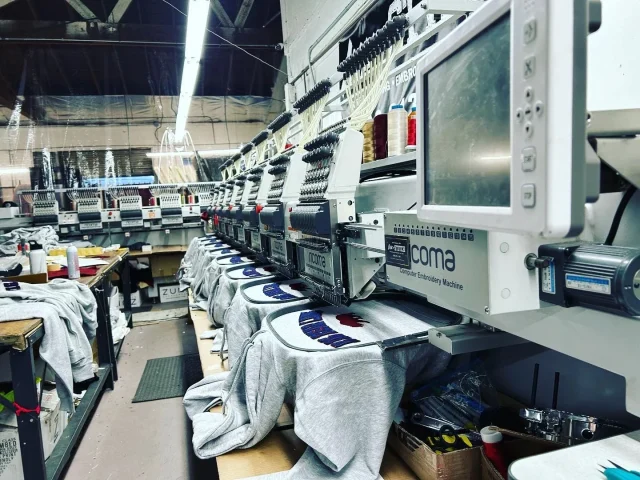
The SBA's lean startup format can fit on one page and suits a plan only you will read. Lenders and investors commonly ask for the traditional format, and this sample follows its sections in the SBA's order: executive summary, company description, market analysis, organization and management, product line, marketing and sales, funding request and financial projections. The SBA wants five years of projections, with the first year broken out by quarter or by month. A clothing line needs the months. The first 100 hoodies are paid for in full weeks before one can be sold, and a quarterly column nets that gap away.
Executive summary
A lender reads the executive summary before anything else and expects to find the loan, the payment and the sales that cover it.
[Brand name] is a Los Angeles LLC selling one oversized hoodie in 100% cotton French terry, 380–440 gsm, with an embroidered design, in black and heather gray, sizes S to 3XL. It retails at $68, between Champion's $65 cotton-polyester Reverse Weave and the $74 plain HF09 that Los Angeles Apparel makes in Los Angeles.
A factory in Guangzhou makes the first 100 hoodies between mid-November and mid-December 2026. They cost $35.39 each delivered to Los Angeles with duty paid, and 200-piece reorders cost $28.61 each. Most sales come through TikTok Shop creators paid a 10% commission. TikTok's fee, the commission, returns and the hoodie itself leave $12.69 an order on the first batch and $18.28 on reorders.
The founder is asking for a $6,500 SBA microloan over five years. Its cost at 13% with a 3% guarantee fee is $195 at closing and $147.89 a month. Fixed costs, the $29 Shopify plan included, come to $176.89 a month. Covering them takes 14 orders a month on first-batch margins and 10 on reorders, against sales targets of 29 to 40 orders in a month with stock on hand. Money from sales overtakes everything spent, the loan aside, in August 2027. The brand ends October 2027 with $3,624.54 in cash, a third order of 200 hoodies paid for and $5,600.10 left on the loan.
Company description
Starting with one style in two colors keeps the first order at 100 pieces, the smallest order that gets the factory's $14.80 price. The sample company is a single-member LLC in Los Angeles, where FedEx delivers the cartons and you pack the orders. You sell to people who want a heavy cotton hoodie in an oversized cut with a design they haven't seen on everyone else, and who aren't paying extra for US manufacturing. Sales run through TikTok Shop and a Shopify store from December 2026, and the monthly targets add up to 351 orders by October 2027.
Market analysis
You set the price against two heavyweight hoodies already on sale in the US. Prices and specs are from each brand's US site in October 2026.
| Hoodie | Price | Fabric | Sizes | Made in |
|---|---|---|---|---|
| Los Angeles Apparel HF09 Heavy Fleece Hoodie, piece-dyed | $74 | 14 oz fleece (about 475 gsm), listed as 100% cotton by resellers | XS–3XL | Los Angeles |
| Champion Reverse Weave Small C Hooded Sweatshirt | $65 | 12 oz fleece (about 407 gsm), 82% cotton and 18% polyester | XS–3XL | Not shown on the product page |
| [Brand name] HD-01 | $68 | 380–440 gsm French terry (11.2–13.0 oz), 100% cotton | S–3XL | China |
Neither comparison hoodie carries a graphic. Los Angeles Apparel sells the HF09 plain, and Champion's has only its small C logo. Your hoodie is lighter than the US-made one and comes from China. A customer pays $68 for the embroidered design on an oversized cotton body, $6 less than a plain hoodie from Los Angeles. Los Angeles Apparel's garment-dyed HF09 costs $78, but your hoodies aren't garment-dyed, which makes the $74 piece-dyed version the fair comparison.
Each dollar off the $68 costs $0.66 an order once refunds, TikTok's fee and the creator's 10% are counted. Dropping to Champion's $65 would cut a first-batch order from $12.69 to $10.72.
Organization and management
You run the company alone in the first year, covering design, posts, customer service and packing, and draw no salary. Three businesses do the rest. The Guangzhou factory makes the hoodies and QC Advisor inspects them at the factory, after which FedEx brings the cartons to Los Angeles and clears them through customs. An RN, the free Registered Identification Number the FTC gives US businesses that deal in textile products, goes on the label in place of your company name, and you register for one before the first order.
Packing at home costs $0.52 an order in Uline's returnable poly mailers, sold at $52 for 100. A second adhesive strip lets the customer reseal the same mailer for a return. A 3PL warehouse would charge $2 to $3 to pick and pack the first item in an order, and the rate cards Fulfill.com surveyed in 2026 carried monthly minimums averaging $517. A minimum that size works out to $14.77 an order at 35 orders a month, most of the $18.28 a reorder hoodie leaves.
Product line
Sizes
Fifty black and fifty heather gray meet the Guangzhou factory's 50-piece minimum per style and together reach its 100-piece price. The factory confirms in writing, before you pay the deposit, that the two colors count together toward that price. A Hangzhou factory on the same marketplace sets its standard minimum at 100 per style and color, and the same order there would start at 200 hoodies.
| Pieces | Guangzhou price per hoodie |
|---|---|
| 50–99 | $16.80 |
| 100–199 | $14.80 |
| 200–999 | $13.80 |
| 1,000 and up | $11.80 |
The size split uses Custom Ink's sales data for adult T-shirts in the US: 14% small, 25% medium, 28% large, 21% XL, 9% 2XL and 3% for 3XL and up. It's T-shirt data and only sets the first 100, while the March reorder is sized from the hoodie's own sales. Half pieces are rounded up in one color and down in the other, and the two colors together match Custom Ink's shares.
| Color | S | M | L | XL | 2XL | 3XL | Pieces |
|---|---|---|---|---|---|---|---|
| Black | 7 | 13 | 14 | 10 | 5 | 1 | 50 |
| Heather gray | 7 | 12 | 14 | 11 | 4 | 2 | 50 |
| Total | 14 | 25 | 28 | 21 | 9 | 3 | 100 |
Heather gray yarn is often blended with polyester. The factory confirms in writing that your gray is 100% cotton, the same as the black, and the labels aren't printed until it does.
Samples
You order two samples. One comes to you by courier, and the other stays at the factory with your signature on it as the sealed reference the inspector checks the bulk order against. The Guangzhou factory refunds its sample fee against a bulk order but doesn't publish the amount. A hoodie sample from a Shenzhen factory on Alibaba.com costs $100, which puts the pair at $200, and the courier adds $80, the top of the $30 to $80 range in Alibaba.com's seller guide to samples.
CBP suspended the $800 de minimis exemption for every shipping mode in interim rules issued on June 24, 2026, and the sample you receive owes duty like any other import: $36.50 on its $100 value, FedEx's $17.50 minimum fee for advancing it and a $2.77 processing fee. The samples come to $336.77 in all. If the Guangzhou refund comes through, its sample fee comes off the bulk order.
Labels
Branding has a 50-piece minimum: embroidery starts at $2.00 a piece and a main label at $1.00. No logo size or stitch count comes with the $2.00, and you budget it for one small chest logo until the factory quotes the stitch count and size.
The main label has to carry fiber content, country of origin and your RN under the FTC's labeling rules, with the country of origin on the front of a label at the inside center of the neck. Care instructions for washing, bleaching, drying and ironing can share that label if they stay legible for the life of the hoodie. One printed label with all of it stays at the $1.00 starting price as long as the factory confirms the price covers the extra text. Hang tags and custom packaging are left out at $1.00 a piece.
Order dates
Every date in the first order works back from Chinese New Year on Saturday, February 6, 2027. According to Seko's planning guide, production orders should be final 8 to 10 weeks before the holiday, by late November or early December 2026. Many factories stop taking new orders 6 to 8 weeks ahead, output starts slowing between January 9 and 16, and factories close from January 30 to February 14.
The samples go in on Monday, November 2, 2026. A sample takes 3 to 7 working days at the Guangzhou factory and about three more with the courier. You pay the 30% deposit by Friday, November 13, once the sample is approved, and production runs 15 to 25 working days to finish between December 4 and December 18, three weeks or more before the slowdown. The other 70% is due after inspection and before the hoodies ship, the split Alibaba.com's seller blog calls the industry standard. FedEx's three days in transit put the hoodies in Los Angeles between December 9 and December 23, and at the late end the first sales come after Christmas.
A reorder paid in the first days of January could still finish before January 30 at the 15-working-day minimum, but it would be made through the slowdown, and rush-order cutoffs fall 3 to 4 weeks before the holiday. You place the 200-piece reorder on Monday, March 8, 2027 instead. Factories reopen between February 20 and March 6 with about 35% of their workers and reach full output four to six weeks after the holiday begins, between March 6 and March 20. The full 25 working days end on April 9, and the hoodies arrive in mid-April. The first 90 hoodies for sale have to last from December to the end of March, and early April has none.
The third order of 200, for the 2027 holiday season, goes in on Monday, August 23. Its 25 working days end on Friday, September 24, a week clear of China's National Day holiday on October 1.
If heather gray sells slower than black, gray stock will still be on hand when black runs out in March, and the reorder can lean toward black. The Hangzhou factory sells a stock hoodie from 2 pieces, a cheaper test of demand than 100 custom hoodies, though a custom main label there needs an order of 100.
Inspection
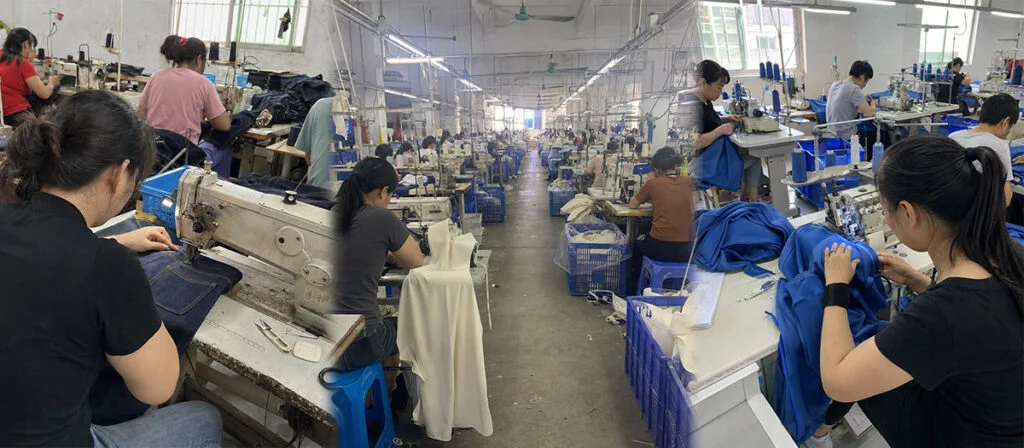
QC Advisor's inspector checks the bulk order at the factory against your sealed sample before you pay the 70% balance. A day costs from $280, with no travel charge in mainland China. General inspection level II under ISO 2859-1 and ANSI/ASQ Z1.4, the usual starting point, means pulling 20 of the 100 hoodies. Accepting AQL 2.5 for major defects, such as an open seam or a crooked logo, and AQL 4.0 for minor ones like a loose thread means one major and two minor defects in 20 still pass. The inspector pulls 32 from a 200-piece reorder, and two major and three minor pass.
The Guangzhou factory takes quality claims for seven days after delivery, with photos, and settles them by replacement, repair or partial refund. Seven days go quickly with 100 hoodies to open and photograph.
Black or gray from a new dye lot can come out a shade off the first run. A swatch of the new lot comes to you for approval against the sealed sample ahead of the March and August reorders.
Marketing and sales
A $68 order on your Shopify store leaves $22.92 at first-batch cost once refunds, the 2.9% + 30¢ card fee, a mailer and the hoodie are paid for. Any ad that costs more than $22.92 per order loses money. Apparel and accessories brands paid a median $36.98 per purchase on Meta between August 2025 and July 2026 in Triple Whale's benchmarks, $14.06 over that line.
You put $300 into a Meta test in January and get your actual cost per purchase. If it comes in under $22.92, ads go into the budget at that cost times the orders you want from them. Above it they stay out, and the forecast has no ad spend after the test.
Most orders come through TikTok Shop's affiliate program, where creators post the hoodie and get a commission only on what they sell. You set it at 10%. FastMoss has no row for unisex hoodies, and womenswear commonly runs from 1% to 18% with a median of 10%. TikTok keeps a 6% referral fee on most US categories, payment processing included, and returns it minus 20% (capped at $5) when an order is refunded.
Return shipping on TikTok Shop in the US is now the seller's cost. You budget every return at $11.67, the commercial price of a 2 lb USPS Ground Advantage label from New York to Los Angeles. Creators need the hoodie before they can post. Ten from the first batch go out free at the same postage, and 90 are left to sell.
The Shopify store's Basic plan costs $29 a month billed yearly, and its card payments cost 2.9% + 30¢. Shopify Payments doesn't return the card fee when an order is refunded. Customers there get 30 days to return and pay their own postage. Every order in the forecast is costed as a TikTok Shop order, and orders through the store cost less.
Retailers expected 19.3% of online sales to come back in 2025 and counted 9% of returns as fraud. Those 9% are costed as hoodies that never go back into stock.
Funding request
You're asking for $6,500 as an SBA microloan, which is debt. Microloans go up to $50,000 for inventory and working capital, at rates between 8% and 13% and terms of up to seven years, and Bankrate lists a guarantee fee of up to 3% of the loan. Budgeted at 13% over five years with the full 3% fee, the loan costs $195 at closing and $147.89 a month from December 2026, $9,068.40 in all. Packaging, closing or underwriting fees vary by lender and aren't in these figures.
The $195 fee comes out first, then $3,538.55 for the samples and the first 100 hoodies landed with duty paid. A year of Shopify Basic takes $348, posting ten free hoodies to creators $116.70 and the January ad test $300. The remaining $2,001.75 is a reserve for April, when the reorder's balance, freight and duty are due while those hoodies are still weeks from sale.
Payments come out of sales from December, and cash stays above zero in every month of the forecast.
Financial projections
Landed cost
| Cost | First order, 100 | Reorder, 200 | Basis |
|---|---|---|---|
| Hoodies | $1,480.00 | $2,760.00 | $14.80 and $13.80 a piece, Guangzhou listing |
| Logo and main label | $300.00 | $600.00 | $2.00 and $1.00 a piece, starting prices |
| Two samples, courier and sample duty | $336.77 | — | Shenzhen sample price, courier, duty and fees |
| Express freight | $350.00 | $700.00 | 0.7 kg a hoodie at $5 a kilogram, door to door |
| Import duty | $649.70 | $1,226.40 | 36.5% of the factory bill |
| Customs entry | $52.08 | $65.24 | Processing fee and FedEx's disbursement fee |
| Inspection | $280.00 | $280.00 | One QC Advisor inspector-day |
| Bank wires | $90.00 | $90.00 | Deposit and balance |
| Total | $3,538.55 | $5,721.64 | |
| Per hoodie | $35.39 | $28.61 |
Each hoodie weighs 0.7 kg packed on the Guangzhou listing, 70 kg for the order. Express courier service from China runs roughly $5 a kilogram and is the cheapest option up to about 150 kg, against about $3 a kilogram and 8 to 10 days for standard air freight from 150 to 500 kg. FedEx at $5 a kilogram brings the 70 kg door to door for $350 in about three days. The same shipment can cost far more without a forwarder or a FedEx account.
FedEx starts billing by volume when a shipment's volumetric weight, at its divisor of 5,000, passes the actual weight. The point for 70 kg is 0.35 m³, or 3,500 cm³ a hoodie, roughly a 30 × 40 cm bag 2.9 cm thick. A 30 × 40 × 1 cm bag per hoodie, the size on the Guangzhou listing, is thin for 440 gsm terry, and you ask for the carton size in the factory's quote.
Air freight from South China to Los Angeles ran RMB 39 to 42 a kilogram on October 13, 2026, in a market observation BSI labels indicative and not a quote. Seventy kilograms at RMB 42 comes to $436.86 at that day's central parity of 6.7298 to the dollar, and BSI doesn't say whether surcharges or delivery are included.
Duty on a cotton knit hoodie made in China comes to 36.5% of the factory bill: the 16.5% base rate under HTS 6110.20.20, the 7.5% Section 301 duty and the 12.5% forced-labor tariff in force since July 24, 2026. All three orders are costed at that October 2026 rate, and a change before a shipment enters the US would change its duty.
A shipment under $2,500 could normally clear on an informal entry. The Section 301 duty takes that away above $250, and the $1,780 first order needs a formal entry. CBP proposed dropping that $250 limit on October 8, 2026, and until a final rule takes effect it still applies. FedEx clears its own shipments and charges a disbursement fee of 2.5% of the duty and tax, at least $17.50, for paying it on your behalf. The first order's entry comes to $52.08 once the $34.58 minimum merchandise processing fee for formal entries, in force since October 1, 2026, is added.
Wires for the deposit and balance cost a median $45 each at US banks.
Margin per order
An order uses 0.824 of a hoodie on average: 0.807 stays with a customer and 0.017 is lost to return fraud. The commission is counted on returned orders as well as kept ones.
| Per $68 order on TikTok Shop | First 100 | 200-piece reorders |
|---|---|---|
| Sale after refunds (80.7% of $68) | $54.88 | $54.88 |
| TikTok referral fee, after refund credits | $3.45 | $3.45 |
| Creator commission at 10% | $6.80 | $6.80 |
| Return labels (19.3% of $11.67) | $2.25 | $2.25 |
| Mailer | $0.52 | $0.52 |
| Hoodies used (0.824 of landed cost) | $29.17 | $23.58 |
| Left per order | $12.69 | $18.28 |
Fixed costs come to $176.89 a month, the loan payment plus Shopify's $29. Covering them takes 14 orders a month at $12.69 an order and 10 at $18.28.
Cash flow by month
Selling costs are the TikTok fee, commission, return labels and mailers on each month's orders. Store and promotion covers the Shopify year and the loan fee in November, creator postage in December and the ad test in January.
| Month | Orders | Sales after refunds | Selling costs | Stock and import | Store and promotion | Loan | Cash at month end |
|---|---|---|---|---|---|---|---|
| Nov 2026 | 0 | $0.00 | $0.00 | $915.77 | $543.00 | $6,500.00 | $5,041.23 |
| Dec 2026 | 15 | $823.20 | $195.30 | $2,622.78 | $116.70 | −$147.89 | $2,781.76 |
| Jan 2027 | 35 | $1,920.80 | $455.70 | $0.00 | $300.00 | −$147.89 | $3,798.97 |
| Feb 2027 | 30 | $1,646.40 | $390.60 | $0.00 | $0.00 | −$147.89 | $4,906.88 |
| Mar 2027 | 29 | $1,591.52 | $377.58 | $1,053.00 | $0.00 | −$147.89 | $4,919.93 |
| Apr 2027 | 20 | $1,097.60 | $260.40 | $4,668.64 | $0.00 | −$147.89 | $940.60 |
| May 2027 | 35 | $1,920.80 | $455.70 | $0.00 | $0.00 | −$147.89 | $2,257.81 |
| Jun 2027 | 35 | $1,920.80 | $455.70 | $0.00 | $0.00 | −$147.89 | $3,575.02 |
| Jul 2027 | 35 | $1,920.80 | $455.70 | $0.00 | $0.00 | −$147.89 | $4,892.23 |
| Aug 2027 | 40 | $2,195.20 | $520.80 | $1,053.00 | $0.00 | −$147.89 | $5,365.74 |
| Sep 2027 | 40 | $2,195.20 | $520.80 | $4,668.64 | $0.00 | −$147.89 | $2,223.61 |
| Oct 2027 | 37 | $2,030.56 | $481.74 | $0.00 | $0.00 | −$147.89 | $3,624.54 |
| Total | 351 | $19,262.88 | $4,570.02 | $14,981.83 | $959.70 | $4,873.21 |
The low point is $940.60 at the end of April, when the reorder has been paid for and most of it is still unsold. Money from sales overtakes everything spent, the loan aside, in August 2027, the tenth month, and the third order puts it behind again in September. October closes with $3,624.54 in cash and 200 hoodies that cost $5,721.64, against $5,600.10 left on the loan.
Sales at 70% of every monthly target leave the second batch on the shelf in August. Paying for the third order on schedule would then take cash $1,836.81 below zero in September, and you'd hold that order back until stock runs low.
Years two to five
Holding 35 orders a month at reorder cost from year two leaves $7,677.60 a year before the store fee and loan payments and $5,554.92 after them, before income tax. The loan's last payment falls in November 2031.