
T-shirt manufacturer for small brands
A ready-made order uses a blank tee that a Chinese factory already makes. We swap the factory's neck label for yours and print your design before the shirts ship. When no factory stocks the fit you want, we make the tee from scratch, in a color dyed to order if you need one.
Get a free quote- 50 shirts
- minimum per style (custom orders count it per color)
- 11–18 days
- door to door in the US for a ready-made order with your labels and no printing
- 31–48 days
- to the US by air for a custom order, if you approve the first sample
- 24 hours
- to get your quote
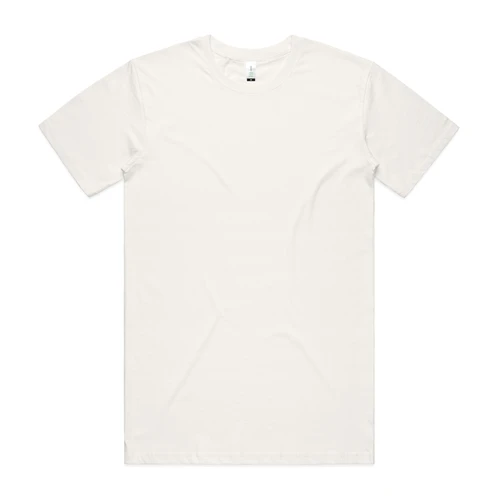
Jersey weight in gsm
Chinese mills quote jersey weight in grams per square meter (gsm). US blank brands list ounces per square yard instead, at 33.9 gsm to the ounce.
| Blank | Listed weight | In gsm | Yarn and build |
|---|---|---|---|
| Bella+Canvas 3001 | 4.2 oz | 142 | 32-singles combed ring-spun cotton, side seams |
| Gildan 5000 | 5.3 oz | 180 | 20-singles cotton, tubular body, 7/8 in rib collar, taped neck and shoulders |
| Comfort Colors 1717 | 6.1 oz | 207 | Garment-dyed ring-spun cotton, tubular body, twill-taped neck and shoulders |
The ready-made blanks we source weigh 180–240 gsm. A brand on the Gildan 5000 or the Comfort Colors 1717 can match its weight ready-made. For a brand selling the 142 gsm 3001, the nearest we can make is a custom tee in our lightest jersey, 160 gsm (4.7 oz).
Combed yarn is spun from cotton with the shortest fibers and the small tangles called neps combed out of it. Jersey knit from it feels softer and looks more even than carded jersey of the same weight. Ring-spun yarn comes out stronger and softer than open-end yarn. Its thickness varies slightly more from one stretch of yarn to the next. The singles number is a yarn count. The 3001's 32-singles yarn is finer than the Gildan's 20-singles and knits a smoother, lighter jersey. We write the jersey weight and yarn type on your quote.
Ready-made and custom tees
You can test a design on a ready-made blank and move the reorder to a custom body in your own colors.
| Detail | Ready-madeStock Match | CustomMade to Order |
|---|---|---|
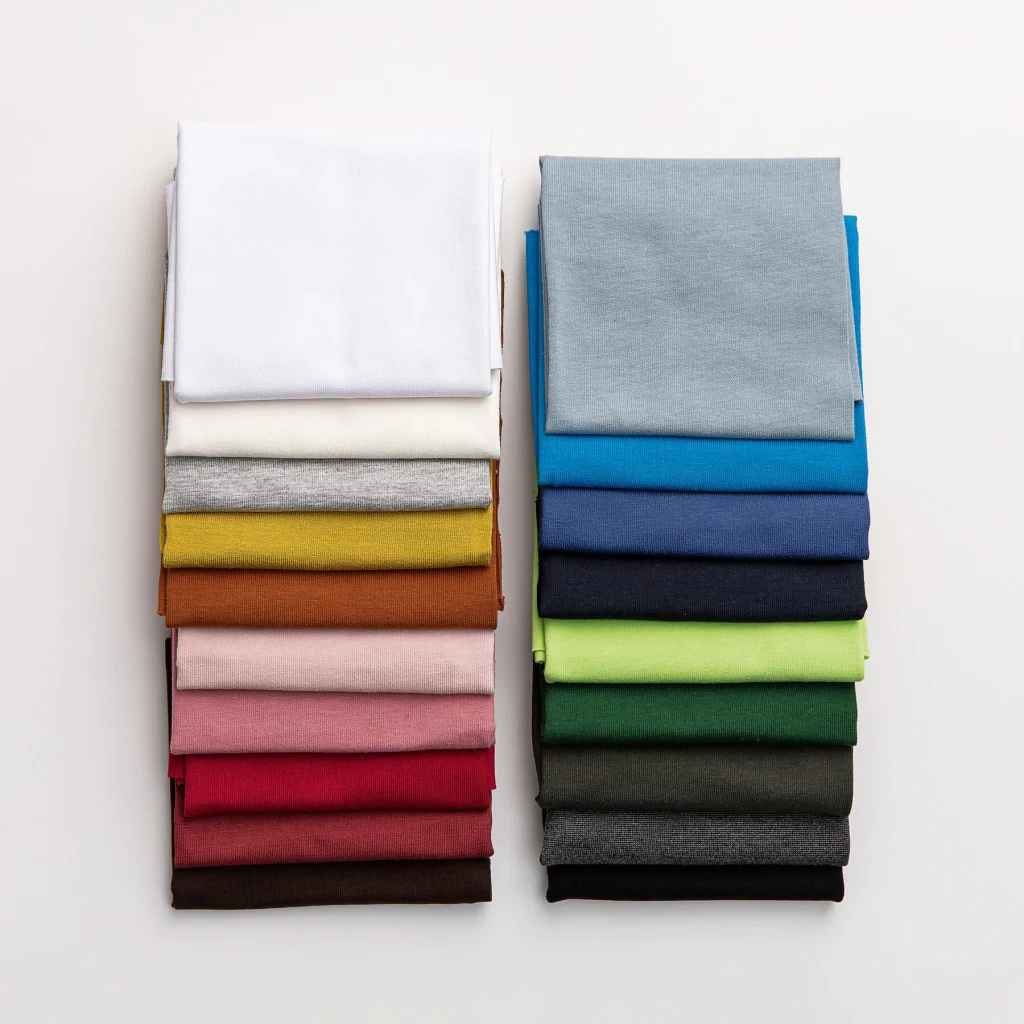
| Fabric | The factory's own jersey | 160–280 gsm jersey: all cotton, a cotton-poly blend, or a tri-blend |
| Color | Whatever the factory has in stock | A stock color from our fabric suppliers, or dyed to your color |
| Fit | The factory's own cuts | Any cut, drafted from your measurements |
| Body | As the factory makes it | Tubular or side-seamed |
| Collar | As the factory makes it | Rib, height, and optional taping to your measurements |
| Neck label | Factory label taken out and yours sewn in | Sewn in during production, included |
| Hang tags, packaging | Hang tag $0.25 and branded packaging $0.45 a piece | Branded packaging included, hang tag $0.25 a piece |
| Sizes | The sizes the factory makes | XXS–6XL |
| Sample | One piece at factory price plus $15–60 express. We deduct its price from your order | Covered by the development fee |
| Minimum | 50 per style, spread over the factory's colors and sizes | 50 per color, split across sizes down to one piece |
| Price | Factory price plus our sourcing fee | Development fee, then a price per piece |
T-shirt prices
Ready-made cotton blanks of 180–240 gsm cost $3.30 to $4.80 a piece at Chinese factories on a 50-piece order. You pay that price plus our 5–12% sourcing fee and $0.35 per shirt for your neck label.
The development fee for a custom tee is $80 to $150. It covers the pattern, the first sample and two rounds of changes. The price per piece includes your label and branded packaging.
| Tees per order | Price per piece |
|---|---|
| 50–99 | $5.50–9.50 |
| 100–299 | On your quote |
| 300–500 | $3.50–6.00 |
| Over 500 | On your quote |
Paid once
- the development fee
- $80–150 for each color dyed to order
- screens and embroidery digitizing for each design
Price drivers
- heavier jersey and ring-spun yarn
- garment dyeing
- 4XL–6XL sizes: 15% more
- each extra ink color or print position
Worked example, 300 custom tees with a two-color front
| Tee | $3.50–6.00 |
|---|---|
| Two screens, $30–90 in all | $0.10–0.30 |
| Printing two colors | $1.00–2.40 |
| Development fee, $80–150 | $0.27–0.50 |
| Dutiable value per tee | $4.87–9.20 |
| US duty on all cotton, 36.5% | $1.78–3.36 |
| Air freight, 60–72 kg at $7–10 a kilo | $1.40–2.40 |
| CBP processing fee, $34.58 minimum | $0.12 |
| Customs broker and bond, $225–400 | $0.75–1.33 |
| Landed cost per tee | $8.92–16.41 |
We clear every order through US customs on a formal entry and bill the duty and fees at cost.
Screen print, DTF and embroidery
We charge $15 to $45 for each screen, one per ink color, paid once per design. Printing costs $0.50 to $1.20 per color on every piece. A three-color chest print 8 inches wide comes to $2.40 to $6.30 a shirt on 50 shirts. The screens account for $0.90 to $2.70 of that. On 300 shirts, they fall to 15 to 45 cents a shirt and the whole print to $1.65 to $4.05.
DTF (direct-to-film) printing puts the design on a sheet of film and heat-presses it onto the shirt. We charge $1.50 to $3.50 a piece for any DTF print up to A4 size (8.3 × 11.7 in), however many colors it has. On 50 shirts, DTF costs less than the three-color screen print unless the screen price sits near its low end. For a one-color logo on 300 shirts, screen printing costs 55 cents to $1.35 and is the cheaper choice. A DTF print bigger than A4, such as an 11 × 11 in full front, is priced on your quote. The print itself is a thin film bonded onto the fabric and feels a little stiff on a new shirt. Hot water and a hot dryer crack it. Put 30–40°C (86–104°F) on the care label.
Embroidery starts with digitizing, the one-time job of turning your logo into a stitch file. We estimate it at $10 to $75 per design and give the firm price on your quote. We then charge $1 to $3 per 1,000 stitches. Most left-chest logos run 2,000 to 5,000 stitches and come to $2 to $15 a piece.
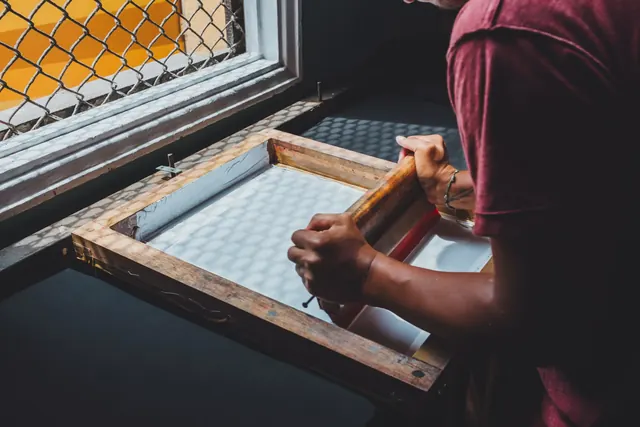
Ready-made tees come from the factory to our workshop, where we swap in your labels and print or embroider them. We develop the print for a custom order alongside its first sample.
Standard print positions
If your artwork doesn't give a print size and distance from the collar, we print at the standard size and position.
| Position | Print size (W × H) | Where it sits |
|---|---|---|
| Left chest | 3.5 × 2 in, at most 4.5 in wide | 2.5–3 in down from the collar and 3.5–4 in off the center line, both to the middle of the print |
| Center chest | 8–10 × 4 in, depending on the shape | 2.5–3 in down from the collar |
| Full front | 11 × 11 in; oversized, up to 12 × 16 in | 3 in down from the collar |
| Full back | 12 × 14 in; at most 13 × 16 in | 3–4 in down from the back collar |
| Upper back | 12 × 4 in | 4 in down from the back collar, centered |
| Sleeve | 2.5 × 1 in | Centered about 1 in up from the sleeve hem |
Custom body
If you don't have a spec sheet, mail us a tee that fits the way you want. We take the pattern from its measurements and match the fabric separately, by weight and fiber content first, then by yarn.
Pattern measurements
- length, straight down from the top of the shoulder beside the collar to the hem
- chest, across the shirt laid flat, an inch under the arms
- shoulders, measured across the back from seam to seam
- sleeve, from where it joins the shoulder to its hem, and how wide the opening is
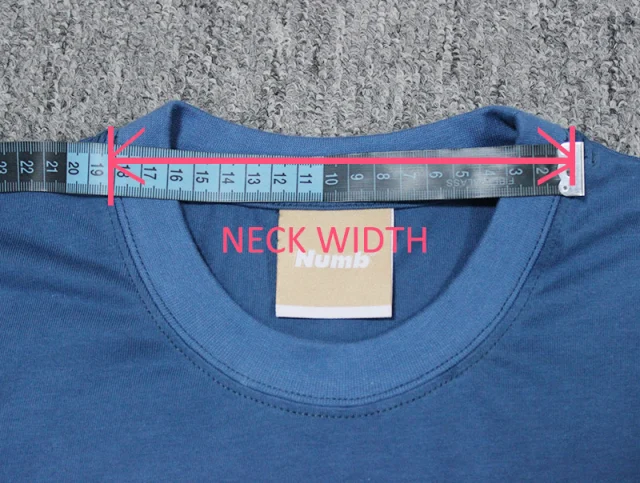
- neck opening, across at its widest, and how far the front neckline dips
- for an oversized or boxy cut, how far down the arm the shoulder seam falls
If your fabric has a print that runs one way, mark that on the sheet. We then cut every panel in the same direction.
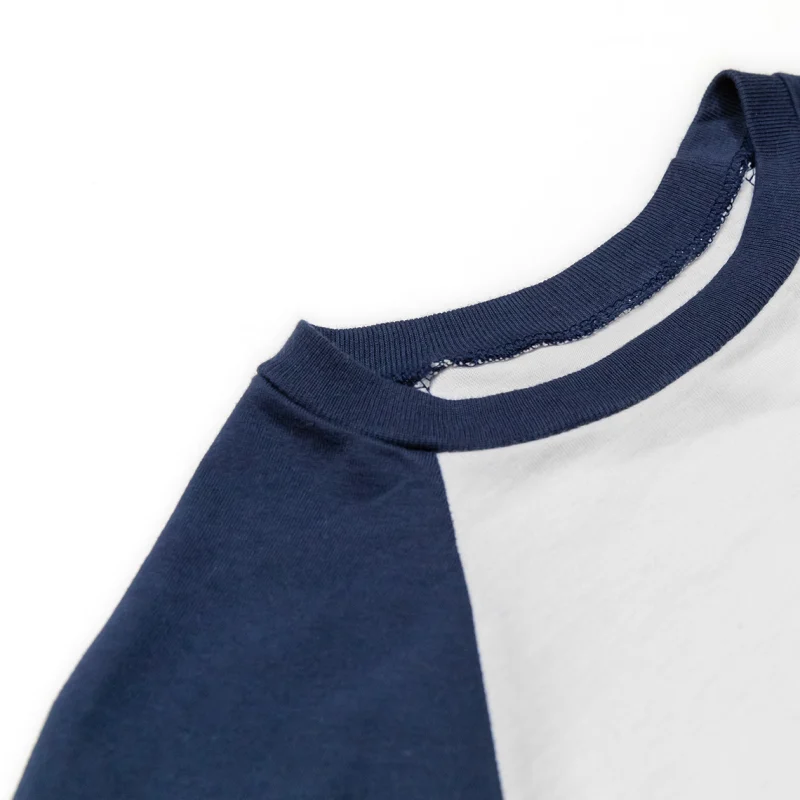
Collar rib and tape
1x1 rib is the thinnest and stretchiest rib knit and suits a fine crew neck. For a heavier, sportier collar like a sweatshirt's, choose 2x2 rib. It has wider ribs and more body. List the finished collar height with your measurements. Rib knitted from 95% cotton and 5% elastane springs back after stretching and keeps the collar flat.
Twill tape over the neck and shoulder seams is optional and costs nothing extra. It covers the raw edges inside the collar and reinforces the seams that take the most strain.
Tubular and side-seamed bodies
Tubular bodies are knitted as one seamless tube. They take less sewing and cost less. The tube comes off a knitting cylinder of fixed width. Your chest widths are limited to the cylinders the mill has. Side seams let us narrow the body at the waist and grade sizes in even steps.
Twist comes mostly from the yarn, whatever the body. After five home washes and tumble dries, ring-spun cotton jersey measured 12.6% skew against 6.2% for open-end. Those figures come from unfinished jersey. Mills lower them in finishing by letting the jersey skew early in dyeing, before the panels are cut. Twist shows first as a side seam swinging toward the front.
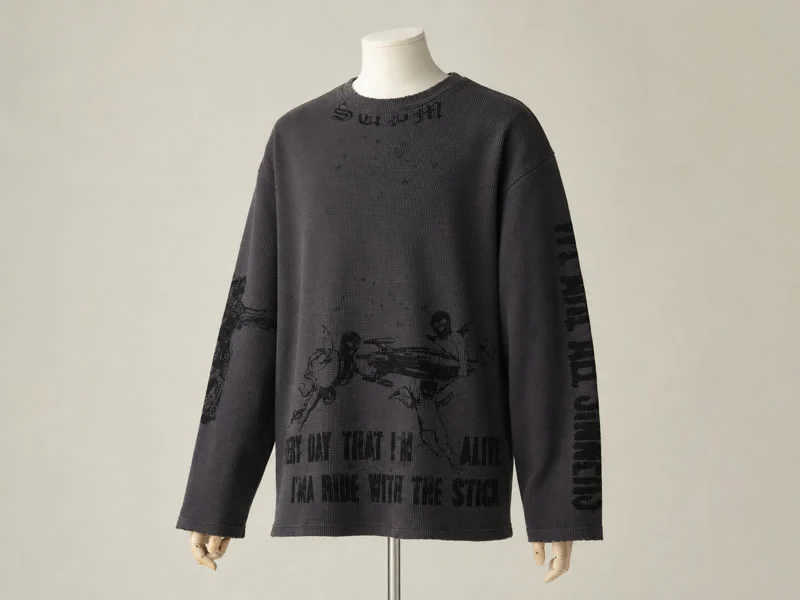
Garment-dyed tees
Garment dyeing is for custom orders only. We sew the shirts from undyed jersey and dye them once they're finished. Shades shift from one dye batch to the next. We compare your bulk with a sample dyed and washed the same way.
Reactive dye bonds chemically with the cotton and holds its color through repeated washing. Pigment dye gives a faded, vintage look from the first wear. It loses a little more color in every wash, most of all along the seams and edges.
We print after dyeing by default. For a worn-in look, ask us to print first. The dye then tints the print along with the fabric. Light inks on a dark dyed tee go over a white underbase so the shirt color doesn't show through. The underbase is one more screen and costs the same as another ink color. The dye-blocking base used under ink on polyester is seldom needed on cotton. Reactive-dyed cotton can bleed into white ink.
Give us the measurements you want after dyeing. We cut the pattern larger by whatever the sample loses in the dye bath. Jersey shrinks more than sewing thread in the bath. To keep the seams flat, we sew at light tension with more stitches per inch.
We sew garment-dyed tees with core-spun thread that has a polyester core inside a cotton wrap. The cotton wrap takes the dye, while the polyester core keeps the thread from shrinking as much as all-cotton thread. Plain polyester thread doesn't take cotton dyes and shows up as contrast stitching. We sew your neck label in after dyeing unless it's woven from dye-resistant label stock.
Extra production days
Our delivery times are for a ready-made order with only your labels added. For a custom order, they're for a stock fabric color and a first sample you approve as it is.
| Ready-made or custom | Extra days |
|---|---|
| DTF print | 3–5 |
| Screen printThe screens are made first | 7–14 |
| EmbroideryIncludes 1–3 days to digitize the logo | 5–10 |
| Custom only | Extra days |
|---|---|
| A color dyed to orderA dyed swatch for your approval comes first | 5–7 |
| Garment dyeing | 7–14 |
| Each extra round of sample changes$30–80 a round | 8–13 |
Duty by fiber content
| Fiber content | Classified as | US duty from China |
|---|---|---|
| 100% cotton | Cotton (HTS 6109.10.00) | 36.5% |
| 60% cotton, 40% polyester | Cotton | 36.5% |
| 50% cotton, 50% polyester | Man-made fibers (HTS 6109.90.10) | 52% |
| Tri-blend, 50% polyester, 25% cotton, 25% rayon | Man-made fibers | 52% |
| 100% polyester | Man-made fibers | 52% |
Gildan 5000 heathers such as Dark Heather are 50% cotton and 50% polyester. US Customs classes a shirt in that mix as man-made fiber. The higher rate adds $0.75–1.43 a tee to the worked example. Duty is charged on the value of the finished shirt, with the print, labels and development fee included. EU duty on T-shirts is 12%, whatever the fiber.
Each US rate is the sum of three duties, as of October 2026. The general duty is 16.5% on cotton or 32% on man-made fibers. The two Section 301 duties on Chinese goods are 7.5% under heading 9903.88.15 and 12.5% under 9903.05.31. The 12.5% forced-labor duty took effect on July 24, 2026. Importers challenged it at the Court of International Trade that same day. Twenty-five states filed their own suit there on August 3. The court heard arguments on September 30 and asked for further briefs by October 16. CBP keeps collecting the duty until a ruling changes it.
Small express parcels are charged duty like any other shipment. The $800 de minimis rule that let them in duty-free stopped covering goods from China on May 2, 2025. The US suspended it for every country on August 29, 2025. The Supreme Court's IEEPA ruling left the suspension in place. CBP added it to its regulations on June 24, 2026. A 2025 act of Congress repeals the exemption outright from July 1, 2027.
Quality checks
We check every custom shirt against your approved sample at no charge. Ready-made orders get a random-sample check at our workshop under ISO 2859-1, General Inspection Level II, with the acceptable quality limit (AQL) at 2.5 for major faults and 4.0 for minor ones. On 200 shirts, the inspectors check 32. The batch passes with up to two major and three minor faults among them. We swap those pieces for good ones before shipping. When the sample turns up more faults than that, we check the whole batch and replace the faulty shirts.
| Check point | Pass mark |
|---|---|
| Fabric | Whole and clean, with no holes or marks |
| In your colors and in register, no more than 1/2 inch from where your artwork puts it | |
| Chest, length, sleeve | No more than 3/8 inch off the size chart (ready-made) or your spec (custom) |
| Neck rib | Springs back after stretching |
| Seams and stitching | Closed, straight seams with even stitches and trimmed threads |
| Labels and shade | The right size label, a straight care label and an even shade across the batch |
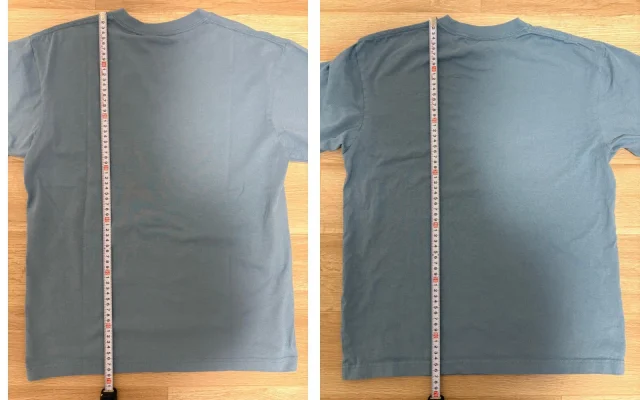
We wash one shirt from your custom bulk before it ships. It then has to measure no more than 3/8 inch off your spec and twist less than 6%.
A full check of every ready-made shirt from the start costs $0.18 a shirt.
Quote checklist
One photo gets you a price. The camo raglan in our case studies was priced from a single photo. To bring the quote close to your final cost, add:
- the blank you sell on now, or the weight you want in gsm or ounces
- how many you need in each color and size
- the country they ship to
- your artwork, with the number of ink colors and where each print goes
You can upload as many as six files at once.
Get a free quote