
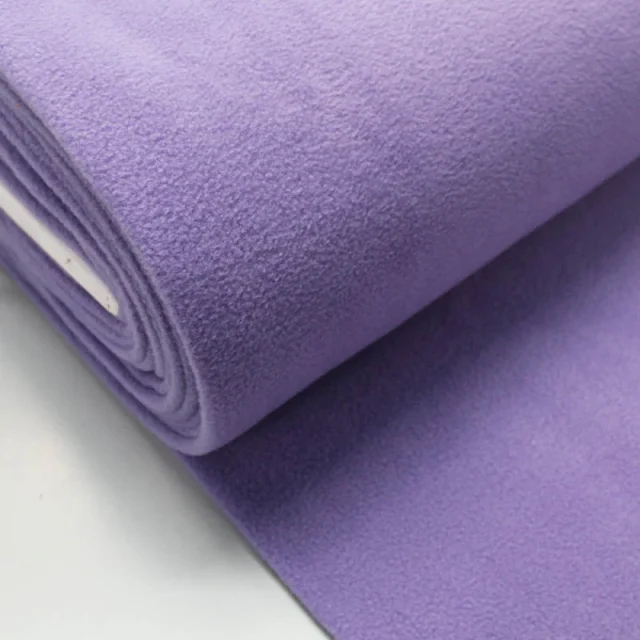
Fleece fabric construction
The softness you pay for in fleece is made after knitting, when rollers covered in fine wire tear open extra loops of yarn knitted into one or two faces of the cloth and fluff the fiber ends into a pile. Those loose ends hold warm air and later work free as pills and lint. Some fleece is trimmed with shearing blades after brushing.

The brush lays the fibers down one way, and a sleeve cut against that direction catches the light differently and looks a shade off from the body once it's sewn on. A correctly cut sample looks like one color from any angle.
Fleece fabric types
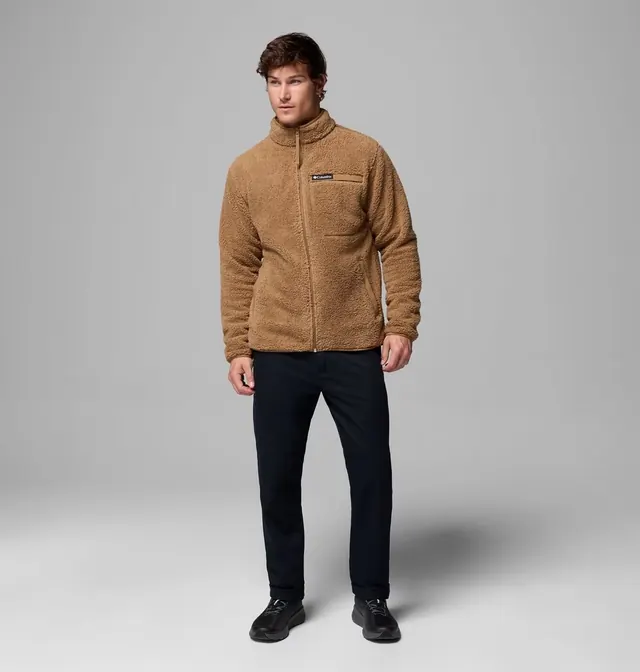
Light and slow to soak up water, all-polyester polar fleece was made mainly for outdoor clothing and is brushed on the face and then on the back. The 100, 200 or 300 on its label is meant as a weight class in grams per square meter, from microfleece below 100 g/m² (3 oz/yd²) upward, but you need a measured weight in g/m² on the order. Only six of ten polar fleeces weighed in 2021 fell in their labeled class. One sold as 100-weight came in heavier than a 200-weight, at 279 g/m² (8.2 oz/yd²).
Turn a hoodie inside out and the fuzz you see is the back of sweatshirt fleece: a loop yarn tied in behind a smooth knit face and brushed open. Three-thread fleece adds a thin binding yarn that holds those loops in. One three-thread fleece had a combed cotton face, an 80/20 cotton-polyester loop yarn and a polyester filament binder. Its finished weight came to 330 to 370 g/m² (9.7 to 10.9 oz/yd²) across four ways of tucking in the loop yarn. A hoodie that feels like cotton on the outside can have polyester in two of its three yarns. French terry has its loops left unbrushed and feels less soft and less warm than fleece.
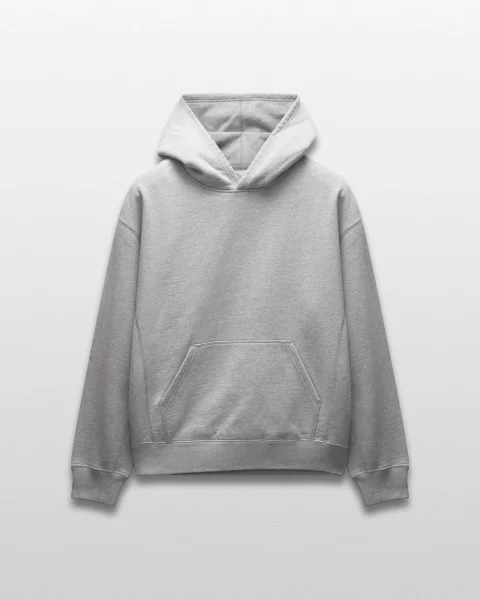
Whether a hoodie's side seams twist or its body shrinks in the wash comes down to how the loop yarn was tucked in. A diagonal tuck let one fleece slant 8.5 to 9 percent in washing tests. A slant that size pulls a side seam around toward the front of a hoodie. A double tuck held the slant to 1 to 1.5 percent but shrank 3.2 percent in length after one wash and 4.7 percent after two, past the plus-or-minus 3 percent accepted under AATCC 135. A double-tuck hoodie hangs straighter if the fabric is preshrunk or the pattern leaves room for that shrinkage.
Sherpa's brushed fibers curl tightly like sheep's wool on a plain knit back. Most sherpa is polyester, though some blends contain natural fibers. It goes mainly into linings for outerwear, gloves, boots and blankets.
Fleece fabric warmth
A fleece's warmth depends on the thickness of its pile far more than on its weight or fiber. Thickness was the only fabric property closely tied to warmth in thermal tests collected for the US Army in 1948, though most of those tests used wool in calm or slow-moving air. Fiber made no difference to heat flow in the blanket tests in that collection. Up to 1 cm (0.4 in), insulation rose almost in step with thickness. In ten polar fleeces measured on a heated plate in 2021, all 2.6 to 6.3 mm (0.1 to 0.25 in) thick, weight bore no relation to warmth, but insulation per inch of thickness barely varied.
You decide how warm a polar fleece will be by ordering it to a minimum thickness in millimeters. Ukraine's defense ministry writes its jacket fleece spec that way: at least 5.0 mm (0.2 in) thick, 250 ± 20 g/m² (7.4 ± 0.6 oz/yd²) and at least 600 liters of air per square meter per second at 50 pascals (118 cubic feet per minute per square foot). Fleece given the usual brush-and-comb finish came out thinner and fell short of that airflow limit. The thinning shows up when thickness is measured on finished fabric.
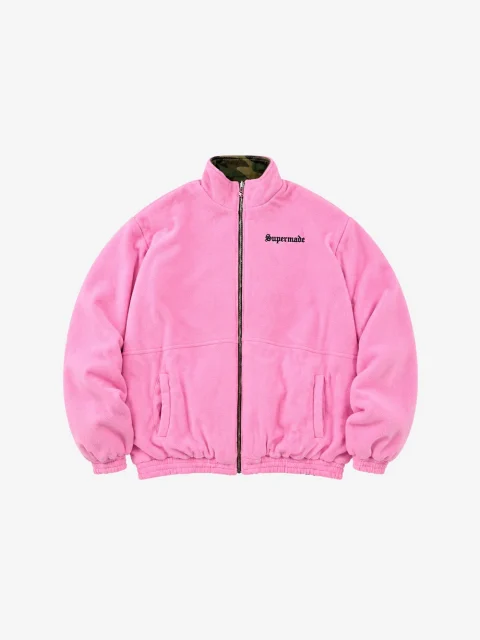
Fleece gives far less warmth for its weight than the synthetic batting in padded jackets and works best as a mid-layer and a calm-weather jacket. The 2021 fleeces gave less than a quarter of the batting's insulation, weight for weight. Heat loss climbed with wind speed in the wind tests collected for the 1948 review. Fleece breathable enough to meet the Ukrainian airflow minimum puts up little resistance to wind.
Wear on the pile
Shedding is recorded as the main quality problem with three-thread garments and the leading reason they come back. Loose fibers that break off the brushed back cling to skin and rub onto other clothes. A back brushed twice held its fibers less well than one brushed once. In one retailer's in-house test, a Martindale machine rubs the brushed side against white cloth, and a score of 3 or better out of 4 for the fibers left behind passes.
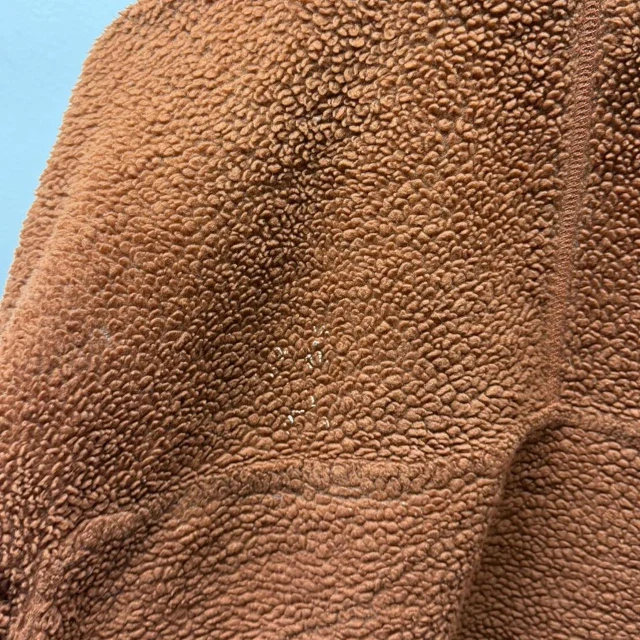
Brushed fabrics can pill more than smooth ones and flatten with wear, and a sherpa lining that has flattened loses some warmth along with its thickness. Pilling on a Martindale machine (ISO 12945-2) is graded from 5 for none down to 1. Three-thread fleece in a 2023 study fell from 3 to 4 at 500 rubs to 2 to 3 at 2,000. Grade 3 after 2,000 rubs is the Ukrainian jacket spec's floor, and polar fleece made to it reached that grade on the face but slipped as low as 2 to 3 on the back. A pilling grade at a stated rub count and a pass on the white-cloth test are the two wear numbers worth writing into a fleece order.
Fiber choice
Cotton is the fiber to favor for a hoodie sold on its feel, though polyester has a practical case. Polyester resists stretching and shrinking and dries much faster than absorbent cotton, but it is prone to static and pilling and takes only low heat in a dryer. The writer of a London blog on premium menswear calls polyester in a cheap sweatshirt a money-saving move and argues that a denser all-cotton knit reaches comparable durability.
Mills save on yarn by knitting cheap sweatshirt fabric with one yarn on two of its layers, but the fabric ends up flat. When you name the fiber and thickness of the face, loop and binding yarns in the fabric spec, you rule out that shortcut and find out whether a cotton face sits over a polyester blend.
US flammability rules
A flame that touches fleece can race across the raised fiber ends and set the base fabric burning. That is the hazard raised-surface fabrics like fleece are tested for under the US flammability standard for clothing (16 CFR Part 1610). You skip the test only when the fleece is made entirely of polyester, wool or four other listed synthetics, in any mix. Cotton anywhere in the fiber content puts the fabric in line for testing, as does spandex. The US Consumer Product Safety Commission (CPSC) lists polyester-cotton and all-cotton fleece garments among the clothing that commonly fails.
Anything sold as sherpa needs its fiber content checked before you treat it as exempt. About 57,000 fleece sweatshirts and similar tops were recalled in 1997 over cotton-polyester fleece in 80/20 and 82/18 blends that failed the standard. That fleece felt like the inside of a sweatshirt and was often called sherpa. Fabric that fails the standard typically burns faster than newspaper.
Adult clothing in a fleece that has to be tested needs a General Certificate of Conformity based on passing results, though CPSC has not pursued firms that skip the certificate on exempt adult clothing since March 2016. Children's clothing needs a Children's Product Certificate whatever the fiber. Any test behind it has to come from a CPSC-accepted third-party lab. Fleece pajamas for children fall under separate sleepwear standards (16 CFR 1615 and 1616) unless they are tight-fitting or sized for infants. An all-polyester hoodie in adult sizes skips the flammability test and, in practice, the certificate.
Sources
- Office québécois de la langue française, Grand dictionnaire terminologique: tissu polaire; tissu polaire moutonné
- Marie Botkin, "Napping," Encyclopedia.com
- Md. Kaikobad et al., Evaluation of physical and mechanical characteristics of three-thread fleece knit fabric for their structural changes, Heliyon, 2023
- Denys Devohuts and Liudmyla Halavska, A differentiated approach to the mechanical finishing of "Polar Fleece" type pile knitted fabric, Fashion Industry, 2026
- Stephen Seeber, By the Numbers: Rethinking Fleece, Backpacking Light, 2021
- Gerald Winston and Stanley Backer, Measurement of the Thermal Transmission of Textile Fabrics, Office of the Quartermaster General, 1948
- Ğassan Asker and Onur Balcı, Investigation of the Effect of Raising and Finishing Process on the Physical Performance of 3-Thread Fleece Fabric, Tekstil ve Konfeksiyon, 2022
- ISO 16322-3:2021, Determination of spirality after laundering, Woven and knitted garments (BSI)
- Permanent Style, What makes a quality sweatshirt
- FabricLink: Polyester; Cotton; Fiber and fabric care
- US flammability rules: 16 CFR §1610.1; §1610.2; CPSC apparel requirements; CPSC clothing guidance; CPSC 2016 certificate policy; CPSC 1997 recall