
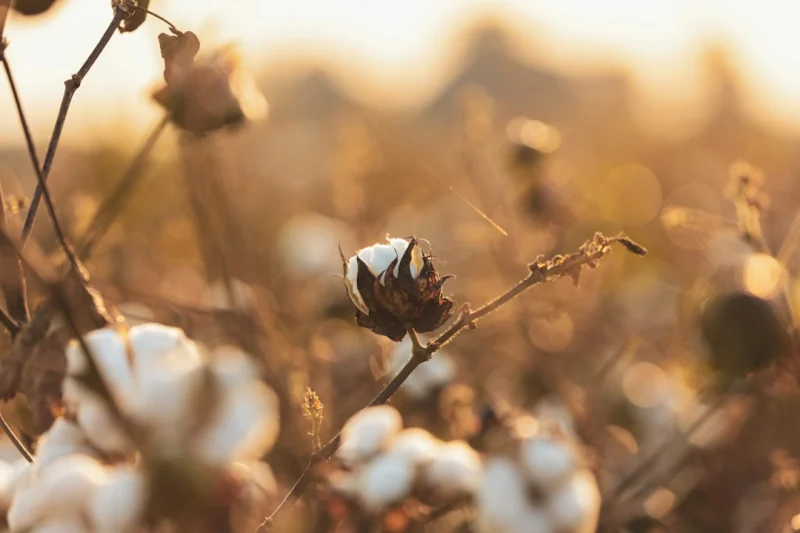
Fiber quality in Pima cotton
US Department of Agriculture classers measure the fiber length of a cotton bale by instrument in hundredths of an inch and record it as a staple code in 32nds of an inch. Pima bales are coded on a separate chart from upland bales. Code 44 stands for 1.36 in (34.5 mm) or longer on the upland chart and for 1.26 to 1.31 in (32.0 to 33.3 mm) on the Pima chart. Pima is known for fiber of 1 3/8 in (34.9 mm) or more. Code 48 on the Pima chart covers 1.37 to 1.42 in (34.8 to 36.1 mm) and takes in that length. Pima from the 2024 crop classed by May 29, 2025, averaged 49.49 on the chart. Texas Pima from that crop averaged 47.26 and fell short of code 48.
Short fibers mixed in with long ones add little strength to yarn and stick out of its surface. They lower a bale's length uniformity index (a score of how closely the fibers in a sample match in length). The 2024 Pima average cleared 85.4, the bottom of the department's very high band, by less than one point. Fiber strength is reported in grams per tex: the force in grams needed to break a bundle of fiber that weighs 1 gram per kilometer. When you ask a spinner for the classing records behind a Pima yarn lot, look for staple 48 or higher on the Pima chart and a uniformity index above 85.4. Classers record a mixture of Pima and upland as code 93. Bales coded 93 have no place in yarn for a 100% Pima label.
| 2024 US crop, classed by May 29, 2025 | American Pima | Upland |
|---|---|---|
| Fiber length | 36.6 mm (1.44 in) | 28.7 mm (1.13 in) |
| Length uniformity index | 86.3 | 81.5 |
| Fiber strength (grams per tex) | 43.0 | 30.2 |
Pima has to appear as the fiber on your yarn and fabric orders before it can appear on your label. Yarn orders for extra-long staple that don't name Pima can be filled with any cotton of that length.
Yarn spun from Pima cotton
CSIRO, Australia's national science agency, grew Pima and upland side by side at Narrabri, New South Wales, in the 2007 season and spun them on full-scale mill machinery. The scientists compared one variety of Pima with one of upland as part of a check on a miniature spinning method for medium-count yarn. Carded ring yarn of 20 tex (30 singles) was spun from the two cottons without the comber that strips out short fiber. Finer yarns have higher singles counts. Pima's strength lead over upland grew from 69 percent in the fiber to 76 percent in the yarn. The Pima yarn was more even along its length. Stretches under half the yarn's average thickness, called thin places, turned up 33 times per kilometer in the upland yarn and never in the Pima. The Pima held a quarter less short fiber by weight than the upland. Neps, small tangles of fiber, were 51 percent more numerous in its yarn. The Pima had been separated from its seed on a roller gin and was less mature than the upland. Neither cotton went through a lint cleaner after ginning.
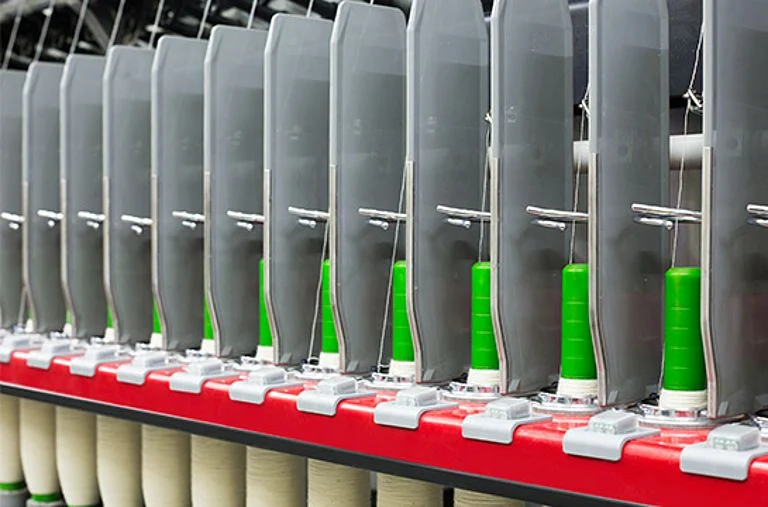
The strength gap between open-end yarn, spun in a rotor, and ring yarn of identical fiber widens with staple length. On staples longer than 1 1/8 in (28.6 mm), a mark that Pima's minimum length clears by 6.3 mm, the gap can reach 25 to 30 percent. Open-end yarn is best suited to short fiber. It comes out more even than ring yarn and tends to have fewer fiber ends on its surface. Open-end Pima yarn can test as much as 30 percent weaker than ring-spun Pima yarn of matching count. Ring-spun yarn is the type to name on a Pima order.
If you order a Pima jersey in combed ring yarn, a comber pulls short fibers out of the carded cotton and removes or straightens the kind of neps counted in the Australian trial's Pima yarn. Mills set combers to remove 8 to 25 percent of the cotton as waste called noil and treat combing as essential for fine counts. Combed yarn is stronger than carded yarn and has fewer short fibers sticking out of its surface.
Jersey knitted from Pima cotton
Six single jersey fabrics knitted at Bahir Dar University in Ethiopia for a 2021 study came from carded ring yarn of an unnamed cotton variety. The fabrics were half-bleached in a hydrogen peroxide bath. The yarns came in 21, 25 and 30 tex (28, 24 and 20 singles) at two twist levels per count that differed by 15 to 30 turns per meter. The fabrics weighed 184 to 224 g/m² (5.4 to 6.6 oz/yd²) and came off a flat knitting machine with seven needles per inch. Finer yarn and higher twist reduced pilling and improved resistance to snags on the ASTM D3939 test. Pilling was graded by the Martindale method of ISO 12945-2 after 5,000 rubs on a scale from 1 for very severe pilling to 5 for none. Grades ranged from 2-3 for the coarsest fabric to 3-4 for the finest yarn at its higher twist. Weight lost after 20,000 abrasion rubs peaked at 10.76 percent in the fabric of the finest yarn at its higher twist (21 tex at 920 turns per meter). The coarsest fabric, knitted from 30 tex yarn, lost 3.5 percent. Weight loss rose as fabric thickness fell across the set.
Researchers at Ege University in Turkey compared compact yarn, spun on ring frames fitted with a mechanical or pneumatic compacting system, with conventional ring yarn at three counts and three twist levels in 2012. They found less pilling tendency in single jersey knitted from compact cotton yarn and measured lower hairiness and higher strength in the compact yarns. Pneumatic compact yarn came out strongest and least hairy in a second comparison within the study. Neither study named Pima as its fiber. If you want a lightweight Pima tee to resist pilling, ask for compact combed ring yarn and a higher twist before you move to a finer count. Heavier tees of coarser yarn suit hard wear: the thicker fabrics in the 2021 tests lost the least weight.
Prices for Pima cotton
| Price received by US growers | American Pima | Upland |
|---|---|---|
| 2023 | $3.20/kg ($1.45/lb) | $1.68/kg ($0.76/lb) |
| 2024 | $3.09/kg ($1.40/lb) | $1.39/kg ($0.63/lb) |
| 2025, preliminary (Aug. to Dec. sales) | $3.22/kg ($1.46/lb) | $1.31/kg ($0.60/lb) |
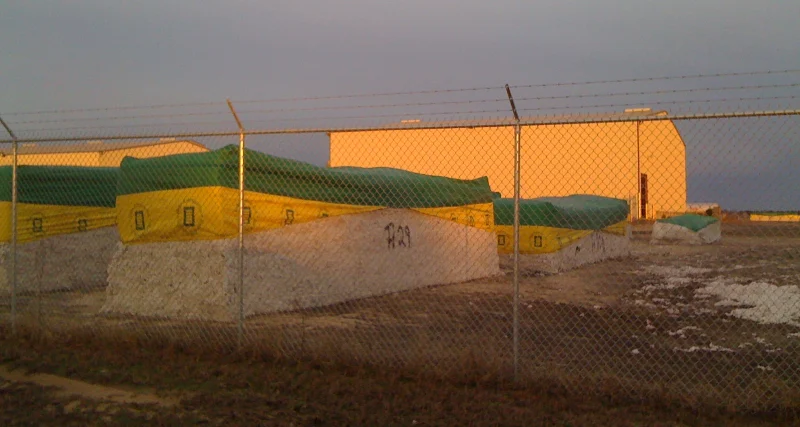
The National Cotton Council says one 217.7 kg (480 lb) bale makes 1,217 men's T-shirts of unstated fabric weight. Pima lint for one of those shirts, 179 g (0.39 lb), cost 57 cents at 2023 farm prices and 58 cents at the preliminary 2025 price. Its premium over upland lint rose from 27 cents in 2023 to 34 cents in 2025. Upland's lower price made up 6.5 cents of that 7-cent rise. The fiber premium falls to 22 cents a shirt for a blend of 65 percent Pima.
Mills that comb out 8 to 25 percent of the fiber as noil need 1.09 to 1.33 kg of carded Pima for a kilogram of combed Pima. At the 2025 premium of $1.91 per kilogram of lint, that much Pima costs $2.07 to $2.54 more than upland before any other spinning waste. All of these figures are farm prices for lint. A mill's price for Pima yarn includes the costs incurred after the fiber leaves the farm.
Fiber content labels
Under the Federal Trade Commission's guidance on cotton labeling, products made of more than one type of cotton can be labeled 100% Cotton or All Cotton with no type named. Pima on a label has to be truthful and appear with the word cotton. Mixes of Pima and other cotton can't be labeled as Pima alone. Pima's share by weight goes on the label of such a mix. Two acceptable forms appear in the FTC's example of a sheet with 65 percent Pima: "65% Pima Cotton, 35% Other Cotton" and "100% Cotton (65% Pima Cotton)." The label 100% Cotton is reserved for products made only of cotton. The FTC's example label for cotton with spandex is "96% Cotton, 4% Spandex." A jersey of 96 percent Pima and 4 percent spandex can be labeled "96% Pima Cotton, 4% Spandex."
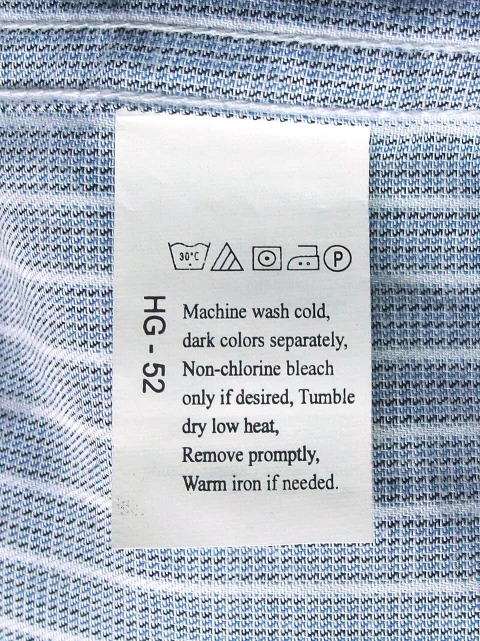
The required fiber content has to appear in type of equal size and conspicuousness. The two parts of the FTC's permissible example appear in matching capitals: "50% EGYPTIAN COTTON, 50% OTHER COTTON." The share of other cotton on your label goes in type that matches Pima Cotton in size. Product names that suggest Pima, such as the FTC's made-up Pimalux, can't be used on textile products with no Pima in them. The acceptable fiber statement for a towel of half Pima and half upland sold as Pimalux is "50% Pima Cotton, 50% Upland Cotton." You state Pima's actual share on the label of any product whose name includes Pima. Fiber percentages can be left out of an ad if the fibers are listed in order of weight and the required fiber information appears together. "Fine Pima Blend Fabric (Pima Cotton, Upland Cotton)" is permissible ad copy under the guidance for a product labeled "90% Pima Cotton, 10% Upland Cotton."
The Department of Justice filed a proposed consent decree in 1997 on the FTC's behalf against a US maker of sheets and towels. The FTC said the company's products were labeled all Pima and contained 6 to 50 percent Pima. The company agreed to pay a $360,000 civil penalty in the settlement and made no admission of a law violation.
Supima licensing
The organization that owns the Supima trademark licenses the name for products made of 100 percent American Pima. Brands and retailers that use the name, small ones included, sign licensing agreements with Supima and agree to use American Pima exclusively in those products. Licensing agreements, more than 360 of them in 32 countries, supplied almost half of Supima's operating revenue in 2012. Supima has a commercial stake in how Pima is labeled. Supima's president at the time said the licensing program for brands and retailers expanded American Pima sales.
Licensees, spinners among them, numbered 370 companies in 39 countries in 2015 and paid for the right to use the name. Their number passed 500 by October 2022. Supima's brand development manager said in 2022 that American Pima was moving from high-end clothes and linens into mid- and low-tier manufacturing. He counted more than 50 new licensees in the previous year, mid-tier manufacturers among them, and said brands were bringing more reasonably priced Supima items to market. Supima's president said that year that the organization had the ability to use blockchain technology for traceability back to the farm.
Proof behind a Pima claim
Supima's executive vice president reported DNA tests on 40 Pima-labeled products that the organization had bought. He presented the results at Supima's 2015 annual meeting. Four of the 40 were all Pima, and the other 36 split into 26 blends of Pima and upland and 10 products with no Pima. The results were to go to the FTC. A Farm Progress reporter wrote that the mislabeled products were priced far below Supima-branded goods. The fiber premium of 34 cents a shirt is a small share of a garment's price, and you can't judge a Pima claim by price.
Supima's 2015 results came from DNA methods built to identify the cotton in retail products. You can have the first fabric lot DNA-tested and reject upland or a blend before any garments are cut. Ask the lab to put the lot number of the sampled fabric in its report. The paper trail from the tested fabric back to the fiber consists of yarn invoices listing Pima and the lot number and classing records free of code 93 for the bales behind that yarn.
Peruvian Pima and Egyptian cotton are claims about the country the fiber grew in. Pima grows outside the United States, and the Pima in the 2007 trial came from a field in New South Wales. Cotton Incorporated, the research and marketing company for US upland cotton, says Egypt grows upland alongside Gossypium barbadense. You learn from a DNA test whether an Egyptian cotton product holds upland.
US customs officials check the growing region of imported cotton with isotope tests in forced-labor reviews. The isotope ratios in cotton depend on the conditions the plant grew under. A lab can tell you whether the fiber is consistent with the region on your label. You back a Peruvian Pima or Egyptian cotton claim with an isotope report from a lab whose reference library holds enough samples from those regions and with a chain-of-custody record from the tested sample back to your lot. Labs differ in how well they isolate cotton from other fibers in a blend. Customs officials don't release a detained shipment on an isotope result alone.
Sources
- US Department of Agriculture: Agricultural Marketing Service, Season To Date Cotton Quality Summary by State, cotton classed through May 29, 2025 and Universal Classification Data Format, the guide to cotton classing records; National Agricultural Statistics Service, Crop Values 2025 Summary, February 2026
- Federal Trade Commission: Calling It Cotton: Labeling and Advertising Cotton Products; civil penalty announcement, June 3, 1997
- Cotton Incorporated: Introduction to Open-End Spinning, technical bulletin TRI 1004, 2003; Cotton Varieties Explained, CottonWorks
- National Cotton Council: What Can You Make from a Bale of Cotton?
- Fiber, yarn and fabric research: Marinus van der Sluijs, Robert Long and Stuart Gordon, An Alternative Miniature Cotton Spinning System, CSIRO, Beltwide Cotton Conferences, 2009; NPTEL, IIT Delhi, Introduction to combing; Desalegn Atalie and Gashaw Ashagre, Tekstilec, 2021; Sevda Altas and Hüseyin Kadoğlu, Journal of Engineered Fibers and Fabrics, 2012
- Trade press on Supima: Farm Progress, October 25, 2012; Farm Progress, November 19, 2015; Western Farm Press, October 2022
- US Customs and Border Protection: Isotopic Testing Guidance, 2024